Quantum Springtime: Harvest Now, Decrypt Later: A Look into How & Who’s Actually Farming Your Encrypted Data, and Why Most of the Crop Rots
For the past few years one of the rabbit holes I have been diving down is one called Quantum-Safe Security. It goes by, and gets referred to by a few different and related names floating out there but the one I opt for is Post-Quantum Cryptography (PQC).
A future where “quantum computers can break today’s encryption” (thus threatening everything from internet banking, to state secrets and intellectual property) is being painted in cybersecurity circles. One phrase the industry has been rallying around is a threat model called “Harvest Now, Decrypt Later” (HNDL).
But I find the metaphor is backwards. Every farmer knows that a harvest is the good bit; it’s the payoff at the end. The concept of harvesting encrypted data I find is more akin to sowing.
Metaphors aside, HNDL is a threat risk, and there are some real scenarios where the migration to systems to protect against that threat needs to be considered if you have sensitive data that has a long shelf-life. However, there are a lot of assumptions and oversights when the statement is simply that bad actors are collecting your encrypted traffic waiting for that day they’ll be able to read it.
There are a lot of difficulties, costs, complexities and effort inferred by that one word – “harvest.”
I decided to take a deeper look at the reality and practicalities of what it takes to get access to gather up, store and one day process that data. For the past two months, my research assistant Claude and I have been peeling back the lid on those assumptions and looking into the details.
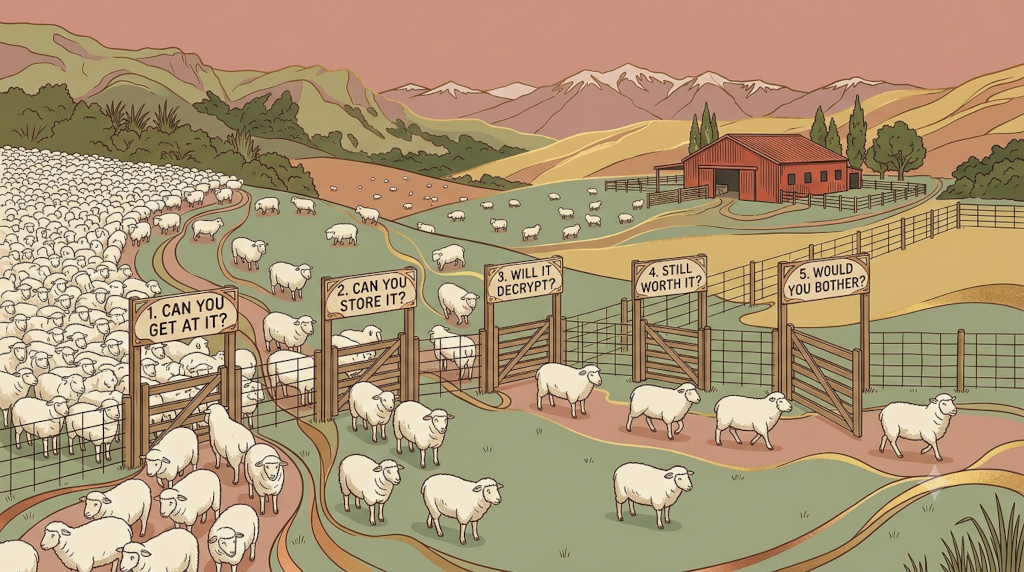
Today I’m happy to release our report. I break it down from first principles using a five-gate framework looking at physical access to the encrypted data, storage economics, decryptability, data shelf life, and adversary motives.
The reality I find is that mass collection of all encrypted traffic fails on economics long before it fails on cryptography. Most data rots before a quantum computer powerful enough to do the damage will be available. The real threat is narrow; it survives only where the data keeps its value for decades and the storage pile stays manageable.
I also ran an internet-wide scan to see what post-quantum cryptography is actually deployed in the wild right now. The results show we are successfully fixing the handshake during the key exchange, but authentication (being sure of who it is you’re actually communicating with over the wire) is completely lagging behind.
You can read the full breakdown, the storage economics, and why most of the crop actually rots over on Kaysec Reports here: https://kaysec.spinsphere.xyz/quantum-springtime-harvest-now-decrypt-later-a-look-into-how-whos-actually-farming-your-encrypted-data/
 English
 日本語
日本語 简体中文
简体中文 한국어
한국어